Mahir Shahriar Tamim
AI Researcher | Explainable & Responsible AI · Computer Vision · NLP · Agentic Systems
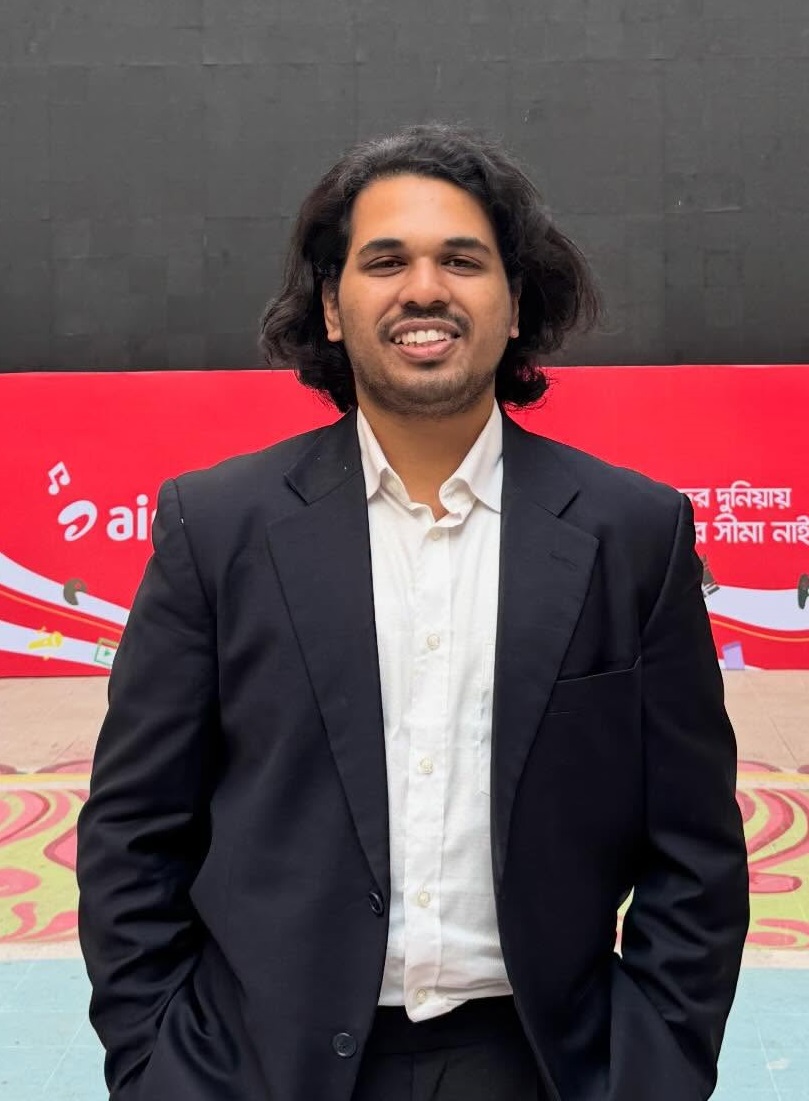
I am an AI researcher and engineer, and I hold a B.Sc. in Computer Science and Engineering from North South University (CGPA 3.86/4.00, 96.5%), where I was awarded a 100% Merit Scholarship for academic performance. Over the past two years I have built a research record across multimodal learning, computer vision, and NLP, with five accepted publications including three Q1 journal papers.
My research centers on a single goal: building faithful, interpretable, and deployable AI systems, with high-stakes decision support as a primary application domain. I pursue this across three interconnected directions:
- [1]Computer Vision and Multimodal Learning: cross-modal alignment, modality balancing, graph-based relational representations, and test-time adaptation under distribution shift.
- [2]NLP and Agentic Systems: large-scale sentiment analysis and LLM evaluation on politically sensitive text, alongside multi-agent systems, tool orchestration, and adaptive decision loops.
- [3]Trustworthy and Explainable AI: calibration, uncertainty, and interpretability of deep models, with explainability as a first-class requirement in medical imaging and high-stakes diagnostic settings.
I am currently a Research Intern at the Computational Intelligence and Operations Laboratory (CIOL), supervised by Dr. Dong-Kyu Chae (Hanyang University), working on visual anomaly localisation, LLM evaluation, and the reliability of tool-using agents. I am also a Backend Engineer at SysModeler.ai, building an AI platform that turns documents and plain-language prompts into editable SysML v2 models.
I collaborate with Dr. Mohammad Ali Moni (Charles Sturt) and Prof. Mohammad Abu Yousuf (Jahangirnagar) on explainable medical AI, and with Prof. Pietro Liò (Cambridge) on test-time adaptation of vision–language models. Earlier I worked with Dr. Nabeel Mohammed and Dr. Shafin Rahman at the NSU Machine Intelligence Lab on multimodal learning, and with Dr. Md. Musfique Anwar on crisis and environmental informatics.
My research has been published in venues including Knowledge-Based Systems (Q1, IF 8.0), Neurocomputing (Q1, IF 6.7), PLOS ONE (Q1), AACL, and IEEE ICCIT, with manuscripts under review at ICLR 2027 (CORE A*) and WACV 2026 (CORE A). I have also taught as a Teaching Assistant for CSE 373 (Design and Analysis of Algorithms), mentoring 600+ students, and I am a Codeforces Expert with several regional ICPC-track placements.
I am seeking PhD and M.Sc. research opportunities. Feel free to email me (mahir.tamim at northsouth dot edu) or connect via the links below if you are interested in collaboration or discussing research.





📰News and Updates
- September 2026: Our paper on evaluating crisis sentiment in Bangladesh's July Uprising is accepted to AACL 2026 (co-first author)!
- August 2026: Joined SysModeler.ai as a Backend Engineer, working on an AI platform for model-based systems engineering (SysML v2).
- July 2026: CAT-GS is accepted for publication in Neurocomputing (Q1, IF 6.7) as first author!
- January 2026: Our rainfall classification framework is published in PLOS ONE (Q1, IF 2.6) as first author.
- January 2026: Joined Obby LLC as a Product Engineer, building agentic and voice-AI systems.
- December 2025: Completed my B.Sc. in CSE at North South University — CGPA 3.86/4.00 (96.5%).
- December 2025: Defended my undergraduate thesis, PNEUMA, a model-agnostic long-term video memory architecture for egocentric question answering.
- December 2025: Paper accepted at IEEE ICCIT 2025 on sentiment analysis during Bangladesh's 2024 mass uprising.
- October 2025: Our multi-teacher knowledge distillation work is published in Knowledge-Based Systems (Q1, IF 8.0).
- April 2025: Joined the NSU Machine Intelligence Lab and RobotBulls as a Research Assistant in computer vision.
- January 2025: Served as Problem Setter for the Intra-NSU Programming Contest.
- January 2024: Awarded a 100% Merit Scholarship by North South University for outstanding academic performance.
📄Publications
Bold denotes my own name. *denotes equal contribution (shared first authorship). Full list on Google Scholar.
Peer-Reviewed Publications
Manuscripts Under Review
Manuscripts in Preparation
💼Experience
Research
- Supervised by Dr. Dong-Kyu Chae (Assistant Professor, Hanyang University), working across computer vision, natural language processing, and agentic systems: training-free visual anomaly localisation, LLM evaluation on politically sensitive text, and the design of reliable tool-using agents.
- Lead author on SphereAD, a hyperspherical self-reference method for training-free anomaly localisation that transfers across domains without per-domain fitting. Under review at WACV 2026.
- Co-first author on Harness Recession, studying when scaffolding around a language model improves task performance and when it constrains an already capable model.
- Research in AI for healthcare and neuroimaging, supervised by Dr. Mohammad Ali Moni in collaboration with Dr. Mohammad Abu Yousuf.
- Co-authored work on multi-teacher knowledge distillation for brain-tumor classification with explainable-AI overlays for resource-constrained deployment, published in Knowledge-Based Systems (Q1, IF 8.0).
- Co-first author on the AACL 2026 crisis-sentiment study, evaluating large language models on Bangla and code-mixed social media text during a fast-moving political crisis.
- Contributed to early-stage exploration of image reconstruction from human brain activity via cross-modal generative models, pairing hierarchical encoders with conditional diffusion.
- Supervised by Dr. Nabeel Mohammed and Dr. Shafin Rahman; carried research prototypes through to deployable real-time vision systems, working across sites with teams in Luxembourg and a robotics lab in Hong Kong.
- Built the perception pipeline end to end, spanning facial morphing, gesture rendering, diffusion-based lip synchronisation, and 3D Gaussian representations.
- Drove down end-to-end latency with GPU-parallelised inference and WebRTC streaming, holding throughput steady enough for live interaction.
- Interim technical demo →
Industry
- Build the backend for an AI platform that turns documents and plain-language prompts into editable SysML v2 models.
- Design the microservices and asynchronous pipelines that keep long-running model generation responsive under load.
- Own the PostgreSQL and MongoDB schemas behind collaborative, versioned system models, and tune the queries that read them.
- Ship Python, Go, and Java under close review, with Docker and CI/CD across both cloud and on-premise deployments.
- Built production multi-agent workflows with tool orchestration, MCP-powered automation, and closed decision loops.
- Shipped AI voice agents and Agentic Council frameworks serving multi-tenant SaaS customers.
- Led cross-functional work across engineering, operations, and product, delivering B2B review automation and AI-powered communications.
- Blog: Multi-Tenant Architecture for AI Voice Agents →
- Built a secure standups, project, and time-tracking app with Next.js, TypeScript, Socket.IO, and Tailwind.
- Integrated NLP autofill, LLM-powered summaries, and smart ticket categorisation.
- Built dashboards with trend detection, anomaly alerts, and PDF/CSV exports, plus email notifications, token revocation, rate limiting, and session management.
- Co-developed a foster-care platform as part of AGT's social initiatives.
Teaching & Leadership
- Prepared lecture and tutorial notes; conducted tutorial sessions outside class hours.
- Proctored exams and graded homework, programming assignments, and assessments.
- Mentored 600+ students through office hours, tutorials, and exam preparation.
- Taught algorithms and contest strategies at the NSU Problem Solvers Bootcamp.
- Authored problems, constraints, test cases, and editorials for Intra-NSU programming contests.
🎓Education
- CGPA 3.86/4.00 (mark percentage 96.5%, ≈ top 2%) — grading policy.
- Awarded a 100% Merit Scholarship for outstanding academic performance (Jan 2024).
- Undergraduate thesis: PNEUMA — Perceptual Noesis for Episodic Universal Memory Architecture. A model-agnostic long-term video memory system for egocentric QA using SQL, vector databases, and knowledge graphs, reaching 72.8% NextQA zero-shot accuracy and 98% recall on temporal BETWEEN queries. Supervisor: Dr. Nabeel Mohammed.
Languages: Bengali (native), English (C1) — IELTS Academic overall 8.0 (Reading 9.0, Listening 8.5, Writing 7.5, Speaking 6.5).
👩💻Technical Skills
Programming Languages: Python, C, C++, Java, JavaScript, TypeScript, Go, SQL
ML Frameworks and Libraries: PyTorch, TensorFlow, Hugging Face Transformers, timm, scikit-learn, OpenCV, NumPy, Pandas, Matplotlib
GPU and Inference: CUDA, Triton, mixed-precision training, ONNX, TensorRT, distributed and multi-GPU training
Machine Learning Methods: Computer vision, vision–language models, multimodal fusion, knowledge distillation, model compression, test-time adaptation, NLP and sentiment analysis, LLM evaluation, agentic systems and tool orchestration, explainable AI
Systems and Tooling: Next.js, MERN, Socket.IO, REST, WebRTC, Git, Docker, CI/CD, PostgreSQL, MongoDB, MCP, LaTeX
🏆Honours & Awards
Academic
| Merit Scholarship | 100% tuition award, North South University, for outstanding academic performance | 2024 |
Competitive Programming
| Expert | Codeforces, max rating 1650 — profile | — |
| 18th / 130 | AUST IUPC (NSU_PyramicSchemers) | 2025 |
| 53rd / 313 | ICPC Asia Dhaka Regional (NSU_EktaNaamDaoFast) | 2025 |
| 67th / 300 | ICPC Asia Dhaka Regional (NSU_PyramicSchemers) | 2024 |
| 29th / 196 | JU National Collegiate Programming Contest (NSU_OneLastTime) | 2024 |
💻Selected Projects
Combined Vision Mamba with U-Net skip connections and ASPP multi-scale context for microscopy grain segmentation. Hybrid LoRA fine-tuning cuts trainable parameters while preserving accuracy.
An interactive web app for learning and visualising algorithms through step-by-step animated execution. Step through real runs, rewind any line, and experiment with your own inputs.
A real-time, audio-driven conversational avatar that drives a human face with voice-cloned audio and synchronised lipsync.
A C++ runtime profiler that adaptively routes workloads to CPU or GPU based on latency and memory metrics, with no manual hardware-specific tuning.
🤝References
- Associate Professor, Department of Electrical and Computer Engineering, North South University.
- Undergraduate thesis supervisor (PNEUMA); co-author on Neurocomputing.
- Email: nabeel.mohammed@northsouth.edu
- Associate Professor, Department of Electrical and Computer Engineering, North South University.
- Co-author on Neurocomputing (CAT-GS).
- Email: shafin.rahman@northsouth.edu
- Program Lead, Program for AI and Digital Health Technology, Charles Sturt University.
- Co-author on Knowledge-Based Systems and AACL 2026.
- Email: mmoni@csu.edu.au
- Professor, Institute of Information Technology, Jahangirnagar University; former Professor, North South University.
- Co-author on Knowledge-Based Systems.
- Email: yousuf@juniv.edu
- Professor, Department of Electrical and Computer Engineering, North South University.
- Co-author on PLOS ONE and IEEE ICCIT 2025.
- Email: musfique.anwar@northsouth.edu
✉Contact
| Name | Mahir Shahriar Tamim |
| Focus | Explainable & Responsible AI · Computer Vision, NLP & Agentic Systems |
| Location | Dhaka, Bangladesh |
| mahir.tamim@northsouth.edu | |
| Website | mahirshahriar1.github.io |
| Google Scholar | scholar.google.com/citations?user=XvaS2jQAAAAJ |
| GitHub | github.com/mahirshahriar1 |
| linkedin.com/in/mahir-shahriar-tamim | |
| Codeforces | codeforces.com/profile/mahir1 |
| CV | Mahir Shahriar CV (PDF) |
I am seeking PhD and M.Sc. research opportunities, and I am happy to hear about collaborations.