CPU vs. GPU: Two Philosophies of Speed
Every time you open a laptop, render a game, or train a neural network, two very different kinds of silicon are quietly arguing about the best way to get work done. One believes in doing a few things extremely well, very fast. The other believes in doing thousands of things at once, even if each one is a little slower.
These are the CPU and the GPU. They aren’t really rivals — they’re specialists with opposite worldviews. And the story of why they ended up so different runs from a single line of code all the way up to the laws of physics. Let’s follow that thread.
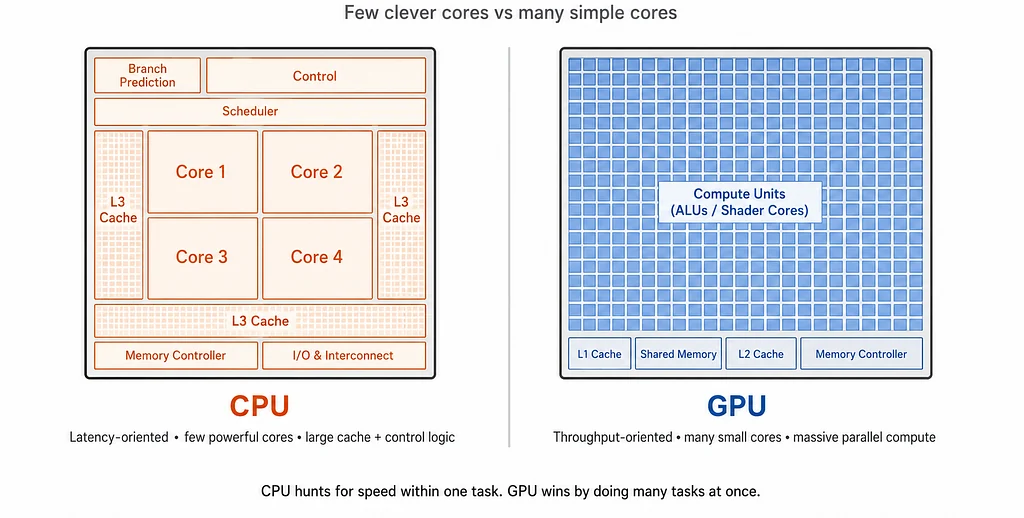
Two Different Goals: Latency vs. Throughput
If you remember one thing, remember this: a CPU is optimized for latency , finishing a single task as fast as possible. A GPU is optimized for throughput, finishing the largest total amount of work in a given time.
A useful picture: the CPU is a Formula 1 car. Blisteringly fast, exquisitely engineered, perfect for getting one passenger from A to B in record time. The GPU is a fleet of a thousand buses. Each bus is slower than the F1 car, but if your job is to move 50,000 people across town today, the buses win — and it isn’t close.
Neither design is “better.” They’re answers to different questions. To see why each chip is built the way it is, we have to drop down to the level of individual instructions.
The Question Behind Everything: Can These Two Instructions Run at Once?
Billions of times a second, a processor faces one fundamental question: can I run these two instructions simultaneously, or does one have to wait for the other?
An instruction is independent if it has everything it needs right now. An instruction is dependent if it must wait for an earlier one to finish first. Watch:
I1:  a = b + c
I2:  d = a + e      // needs 'a' from I1 — DEPENDENT
I3:  f = g + h      // needs nothing from I1 or I2 — INDEPENDENT
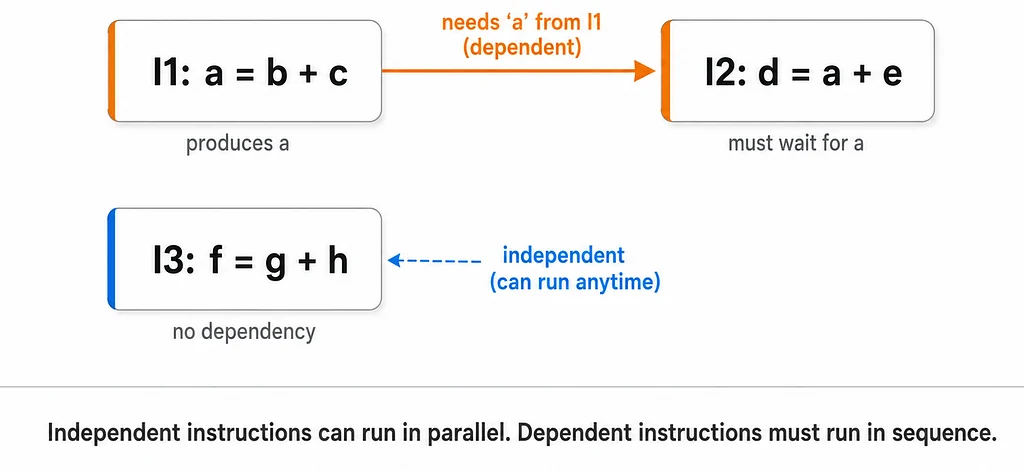
I2 can't start until I1 produces a — a true data dependency. I3 needs nothing from either, so it could run before, after, or alongside them with no change to the result.
This distinction is the hinge the entire CPU-vs-GPU debate swings on. Independent instructions can run in parallel — they’re the raw material of speed. Dependent instructions must run in sequence — a long chain of them is irreducibly serial, because no hardware can make a value appear before it’s been computed.
The amount of independent work hiding inside a single instruction stream has a name: Instruction-Level Parallelism (ILP). The real difference between a CPU and a GPU is simply where each one goes looking for parallelism.
Inside the CPU: Manufacturing Independence
A CPU assumes it’s been handed one thread of mostly sequential code, riddled with dependencies, and that its job is to wring every drop of hidden parallelism out of it. So it spends a staggering fraction of its transistors not on raw math, but on cleverness:
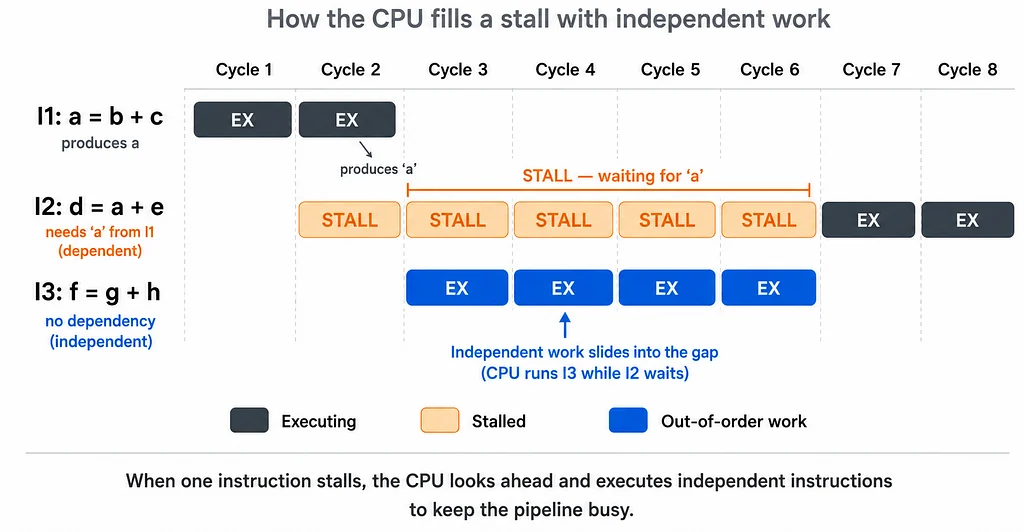
Out-of-order execution. When I2 stalls waiting on I1, the core doesn't sit idle — it scans ahead, finds the independent I3, and runs it now, filling the gap.
Register renaming. Some dependencies are fake, created only because two instructions happen to reuse the same register name. The CPU quietly hands them separate physical registers so they can proceed in parallel.
Superscalar issue. Multiple execution units let the core launch several independent instructions in the same cycle.
Branch prediction and speculation. Even control dependencies — where the next instruction depends on a branch — get broken. The CPU guesses the outcome and races ahead before the answer is confirmed.
Large, multi-level caches (L1/L2/L3). Frequently used data is kept physically close to the core, so a single thread rarely has to wait on slow main memory.
Every one of these tricks exists to keep one thread of execution moving smoothly despite its dependencies. That’s why CPUs dominate messy, branchy, unpredictable work operating systems, browsers, business logic full of “if this, then that.”
It also exposes the CPU’s great weakness: the long dependency chain, where every instruction needs the result of the one before it. With no independent work to interleave, even the cleverest out-of-order engine stalls. The code goes latency-bound — limited purely by how fast each link in the chain can resolve.
The CPU’s philosophy: dependencies are the enemy, so build expensive machinery to manufacture independence out of serial code.
Inside the GPU: Outnumbering the Problem
A GPU refuses to play that game. Out-of-order engines are costly in transistors and power, so the GPU spends those resources on raw arithmetic instead — packing in thousands of simple cores rather than a few complex ones. NVIDIA groups them into Streaming Multiprocessors and executes threads in lockstep bundles of 32 called warps, under a model named SIMT (Single Instruction, Multiple Threads).
So how does it cope when a thread hits a dependent instruction that has to wait.. say, a slow memory load? It does something almost insolently simple: it switches to a different thread.
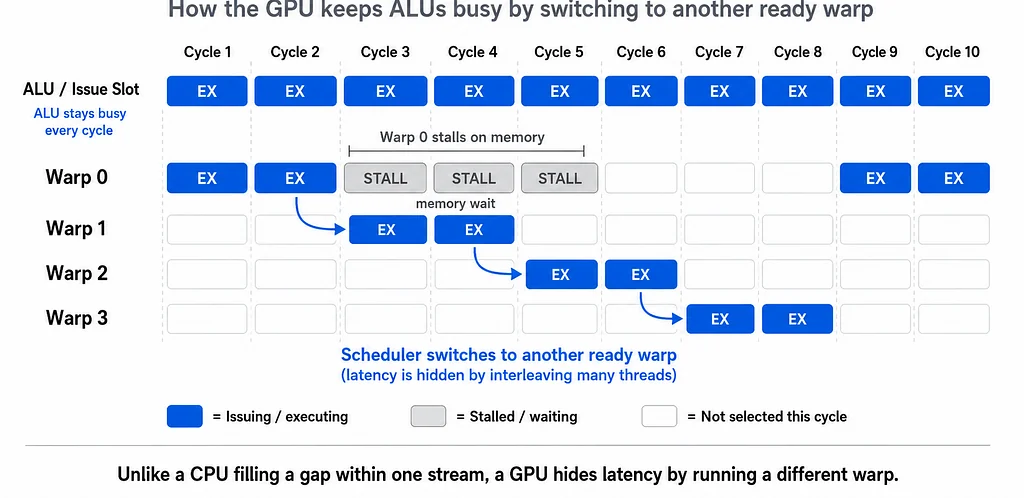
A GPU keeps tens of thousands of threads resident at once. When one warp stalls on a dependency, the scheduler instantly swaps in another warp with independent work ready to go. With so many threads in flight, there is always something to compute, so the stall in any single thread is completely hidden behind the progress of all the others. This is why a GPU needs neither giant caches nor out-of-order logic , and why it pairs all those cores with enormous memory bandwidth (GDDR or HBM) to keep them fed.
Here’s the crucial shift, and the heart of the whole story, where the independence comes from. The CPU hunts for independence within one instruction stream (ILP). The GPU assumes independence across thousands of separate streams , Thread-Level Parallelism, the natural shape of data-parallel work like graphics, simulation, and machine learning.
A GPU doesn’t make a dependency chain finish faster; a single thread might crawl through it. But because thousands of independent threads keep the arithmetic units saturated, total throughput stays sky-high.
The GPU’s philosophy: dependencies within a thread are fine , just have so many independent threads that the stalls never show.
Same Truth, Two Strategies
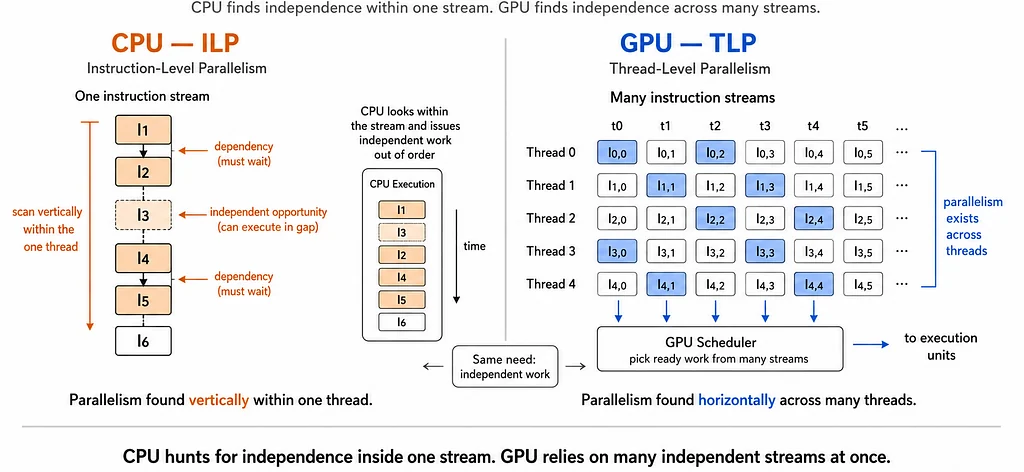
Step back and the symmetry is elegant. Both chips need independent work to stay busy; they just source it from opposite places. Four dimensions tell the whole story:
Where parallelism comes from — CPU: within one thread (ILP). GPU: across many threads (TLP).
When an instruction stalls — CPU: reorder and run other independent work. GPU: switch to a different ready warp.
Cost of long dependency chains — CPU: stalls the core, goes latency-bound. GPU: slows one thread, but total throughput holds.
What the transistors are spent on — CPU: out-of-order logic, register renaming, speculation, big caches. GPU: sheer thread count, fast context switching, memory bandwidth.
There’s even a tidy rule of thumb beneath it. To hide a memory latency of L cycles while keeping a unit running at throughput T, you need roughly L × T independent operations in flight at all times. The CPU assembles that pool from instruction-level parallelism plus a few threads. The GPU brute-forces it with raw thread count.
Which raises the real question: why did computing split into these two camps in the first place? For that, we have to look at a handful of laws — some mathematical, some brutally physical.
The Laws That Forced the Split
Moore’s Law — The Free Lunch
In 1965, Gordon Moore observed that the number of transistors on a chip roughly doubles every two years. For decades this was the engine of progress: more transistors, more capability, almost for free. Both CPUs and GPUs rode the wave. It has slowed as transistors approach atomic scale, but it set the stage for everything that followed.
Dennard Scaling — And the Day It Broke
Transistor count isn’t the same as speed. That was Dennard Scaling (1974): as transistors shrink, their power density stays roughly constant, so you could keep raising clock speeds every generation without melting the chip.
Then, around 2005, Dennard Scaling collapsed. Transistors kept shrinking, but power density started climbing — slamming the industry into the “power wall.” You could no longer simply crank the clock. The free lunch of “faster every year” was over.
This is arguably the single most important event in modern computing. With clock speed dead-ended, engineers pivoted to a new strategy: if you can’t make one core faster, add more cores. That decision launched the multicore CPU and made the massively parallel GPU look like the future. Parallelism stopped being a niche and became the only road forward.
Amdahl’s Law — The Pessimist
So we add more cores. Problem solved? Not so fast. Amdahl’s Law (1967) delivers the bad news: the speedup from parallelization is capped by the part of a program that can’t be parallelized.
Speedup = 1 / ( (1 − p) + p / N )
where p is the parallelizable fraction and N the number of processors. The brutal implication: if even 10% of your program is stubbornly serial, then no matter how many cores you throw at it , even infinitely many, you’ll never go more than 10× faster. The serial bottleneck wins.
This is exactly why CPUs still matter in a GPU-obsessed world. Real programs have serial sections , those very dependency chains we met earlier, and you want a fast, clever core to chew through them.
Gustafson’s Law — The Optimist
For a while, Amdahl made massive parallelism look pointless. Then John Gustafson countered in 1988 with a different observation: in practice, when we get more compute, we don’t solve the same problem faster, we solve a bigger one. A finer weather grid, a larger neural network, a more detailed scene.
Speedup = N − (1 − p)(N − 1)
Amdahl asks, “How much faster can I solve this problem?” Gustafson asks, “How much bigger a problem can I solve in the same time?” For machine learning, the answer has been “enormously bigger”, which is precisely why GPUs swallowed AI whole.
Pollack’s Rule — Why Many Small Beats Few Big
One last gem. Pollack’s Rule says a single core’s performance grows roughly with the square root of its complexity. Double a core’s transistors and you get only about 40% more single-thread speed. That’s a terrible deal for parallel work: instead of one big core for +40%, you could build two simpler cores for nearly 2× the throughput. Pollack’s Rule is the mathematical blessing on the GPU’s “many small cores” design , and the reason chips stopped chasing ever-bigger single cores.
So, Which One Wins?
Neither. And that’s the point.
The future isn’t CPU or GPU.. it’s heterogeneous computing, where each chip does what it was born for. The CPU is the brain: orchestrating, deciding, and powering through the serial dependency chains that Amdahl warned us about. The GPU is the muscle: devouring the massively parallel number-crunching that Gustafson taught us to embrace. Increasingly, specialized accelerators like NPUs and TPUs join the team for narrower jobs.
It all traces back to that one tiny question, can these two instructions run at once? The CPU spends transistors to manufacture independence out of stubbornly serial code. The GPU assumes independence already exists in abundance and bets everything on having enough of it. Physics, by killing Dennard Scaling, forced both bets onto the table at the same moment.
And modern computing runs on the conversation between them.