Multi-Tenant Architecture for AI Voice Agents: A Practical Guide
What it actually takes to serve many businesses from one real-time voice platform — the parts that aren’t the AI.
The voice model is the demo. The platform around it is the product.
Building a voice agent for one business is a weekend demo: one number, one script, one happy path. Building a voice agent platform for many businesses is a different job entirely. Now you answer for dozens or thousands of companies, each with its own identity, hours, rules, escalation paths, and customer data — and none of them can ever leak into another.
That is the real architecture problem, and it has almost nothing to do with speech. This is a practical guide to the parts that do the quiet work, with the patterns I’d reach for in each. The code is illustrative pseudocode, not tied to any one framework.
What is a multi-tenant voice agent?
A multi-tenant voice platform is a single running system that serves many businesses (tenants) at once. The telephony, the real-time AI layer, the datastore, and the workers are shared. What’s not shared is everything the tenant cares about: their identity, their data, their rules, their bill.
The useful mental model is a shared office building. Lobby, elevators, and security desk are shared. But every company has its own locked room, its own keys, and its own records. Shared infrastructure, tenant-specific behavior.
Underneath, the agent reaches the voice model over SIP — the same session protocol phones use — so to the model, the agent simply is a phone call. The platform is the broker between the telephony layer and that model. Its first job runs before anyone speaks.
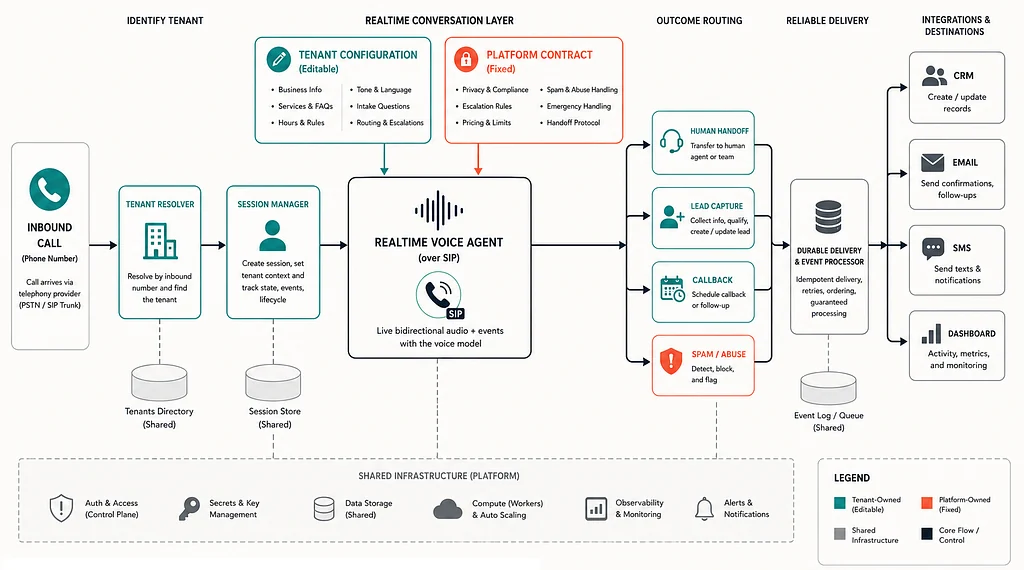
The core reality: a call is not a request
Most backends are request/response. A user clicks, the server answers, the interaction ends. A call is not a request — it’s a live session with a beginning, a middle, and a dozen possible endings. The caller hangs up. The provider disconnects. A human joins. A handoff is missed. An event arrives twice, late, or out of order.
Get this one fact wrong and nothing else holds. Almost every pattern below exists because a phone call is a stateful, unreliable, real-time session — not a tidy HTTP round trip.
1. Tenant resolution: the first decision
The first question is never “what should the AI say?” It’s “which business does this call belong to?” You resolve that from an inbound identifier — usually the number the call arrived on — and that tenant record becomes the root of the session: name, hours, services, routing, language, and the things the agent must never say.
// Resolve the tenant before any model session starts.
const tenant = await tenants.findByInboundNumber(call.to);
if (!tenant) return reject(call);   // unknown number -> NO default tenant
session.tenantId = tenant.id; // root of everything downstream
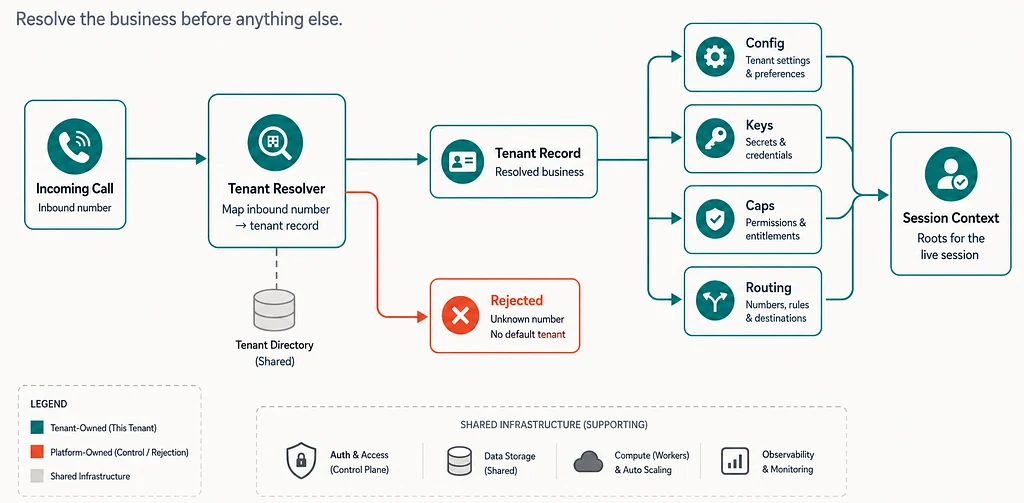
Two non-negotiables. It must be fast and deterministic — a caller is waiting in real time, and there’s no spinner to hide latency behind. And there is no default tenant; an unresolved number gets rejected, because a fallback here is a leak waiting for a wrong number.
2. Configuration vs. contract: how the prompt is built
The biggest mistake is storing one giant editable prompt per tenant and letting it control everything. That’s fine for a demo and dangerous in production. Split the instructions into two layers.
- Tenant configuration — business-specific content: name, services, hours, tone, FAQs, intake questions. Lives in the datastore. Freely editable.
- Platform contract — non-negotiable behavior owned by the system: privacy, escalation, pricing limits, spam and emergency handling, handoff protocol. Lives in code.
Assemble the final instructions at runtime. The contract lives in code, outside anything a tenant or caller can edit, and is declared authoritative — explicitly overriding the body on any conflict:
const body   = fill(tenant.promptBody, tenant.facts);  // tenant-owned
const prompt = body + "\n\n" + PLATFORM_CONTRACT;       // code-owned, wins
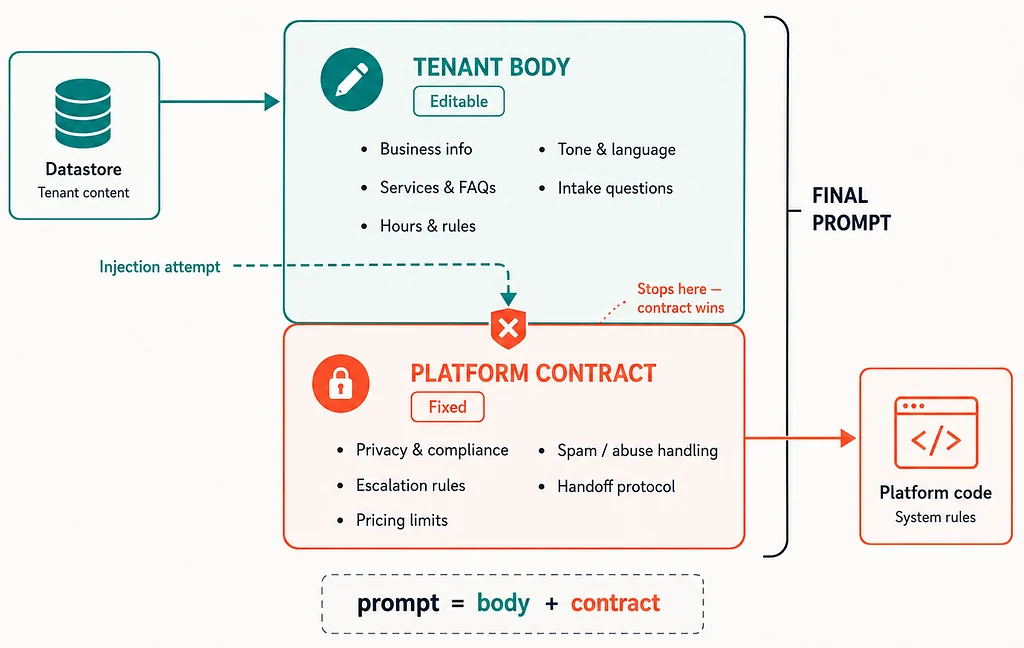
That separation is what reduces prompt-injection risk. A tenant — or a caller talking to the agent — can only write into the body, never the contract, so they can’t simply edit the safety rules out. But be honest about the limit: prompt precedence is a strong nudge, not a guarantee. The real enforcement lives outside the prompt — tool-call allowlists, output checks, and refusal guards in code that a model can’t be talked out of, because the unsafe action simply isn’t reachable.
Tenant configuration says who the agent speaks for. Platform contract says how it is allowed to behave. A tenant can edit the first. Never the second.
3. Session state and idempotent events
Each active call needs a session record tracking the tenant, the caller, the current state, the active AI session, any handoff attempt, the outcome, and the timestamps that matter. It can start in memory keyed by a room id; in a bigger system it moves to a shared store so multiple workers can participate safely.
The hard rule: events mutate session state, they don’t create chaos. Webhooks arrive late, twice, or out of order, so handlers must be idempotent.
function onCallEnded(roomId) {
  const s = sessions.get(roomId);
  if (!s || s.state === "cleaned_up") return;  // 2nd delivery -> no-op
  cleanup(s);
  s.state = "cleaned_up";
}
If “call ended” arrives twice, you clean up once. If a handoff event arrives after the caller already hung up, you ignore it. If an AI session disconnects after the call ended, it does not kick off a new workflow. This isn’t glamorous code — it’s the difference between a demo and a platform that survives real callers.
4. Data isolation: scope every query
Isolation is not a billing model, it’s a trust model. One tenant’s transcripts, summaries, leads, and caller names must never be visible to another. The enforcement point is the query: every read and write is scoped by tenant id.
// Correct: scoped to the active tenant
const leads = await db.lead.findMany({ where: { tenantId } });
// Catastrophic: one missing line exposes every tenant
const leads = await db.lead.findMany();
Relying on every developer to remember that filter forever is not a strategy, it’s a countdown. Push scoping into a place it can’t be skipped — a repository or middleware that injects the tenant id automatically, or a database-level filter:
// Global query filter: the tenant id is applied whether you remember or not
model.entity("Lead").hasQueryFilter(l => l.tenantId === ctx.tenantId);
For the data model itself, you’ll land somewhere on this spectrum:
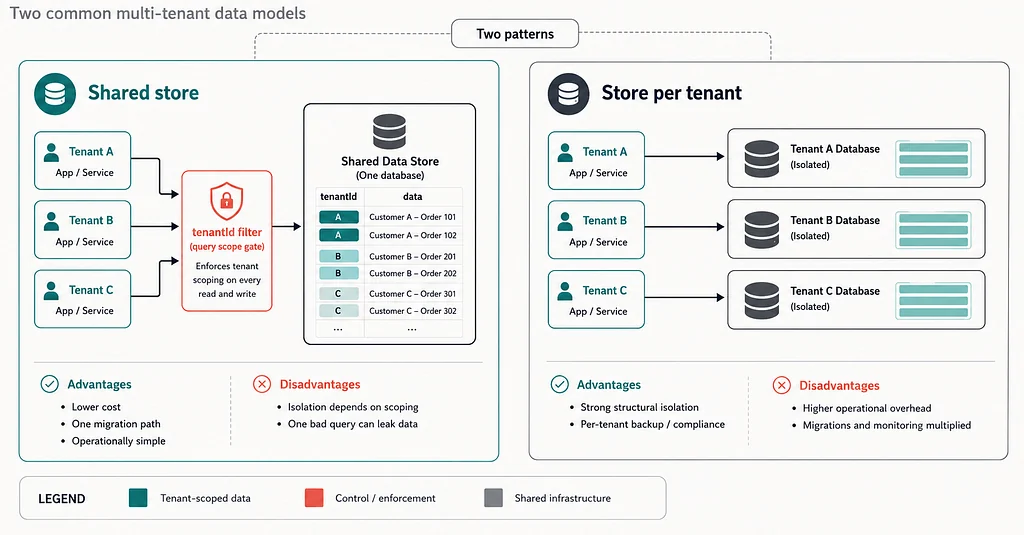
Shared store, tenant id per row — Advantages: cheapest to run, one migration, efficient. Disadvantages: isolation rests on application discipline; one bad query risks everyone.
Store per tenant — Advantages: structural isolation, per-tenant backup, easier compliance. Disadvantages: heavy operations, migrations multiplied, more to monitor.
Neither is “better.” Shared is the right default for most voice platforms; isolate the tenants whose data sensitivity or SLA actually demands it, and don’t be dogmatic about the rest.
5. Credential and cost isolation
Real-time voice gets expensive fast, and shared infrastructure has a failure mode pure isolation doesn’t: the noisy neighbor. One misconfigured or runaway tenant can starve everyone. Meter per tenant.
- Credentials: support shared platform integrations and bring-your-own keys, without ever mixing them across tenants.
- Cost: per-tenant usage tracking, spend caps, and concurrency limits so one account can’t run up shared cost.
if (await usage.spendThisMonth(tenantId) >= tenant.spendCap) {
  return degradeGracefully(tenantId);   // their weight lands on their floor
}
6. Handoffs are workflows, not side effects
The agent shouldn’t always try to finish the call itself. The right outcome might be taking a message, booking a slot, escalating to a human, or rejecting spam. Treat each as an explicit, observable workflow — not a fragile reaction to a single model response.
The agent can ask for a handoff. The platform decides what actually happens.
A handoff workflow checks the tenant’s routing rules, tries to reach the right person, keeps the caller informed, updates session state, and records the result — through controlled system actions, so it’s testable and traceable rather than improvised live.
7. Durable delivery: never lose a result
After the call ends, the business still needs the outcome — a lead, a summary, a missed-call alert, a CRM update. From the tenant’s side, that delivery is the whole point, and it’s where data quietly disappears, because “save it” and “send it” fail independently.
Use a transactional outbox: write the result and enqueue its delivery in the same transaction, then drain the queue with retries.
await db.transaction(async (tx) => {
  await tx.lead.insert(lead);
  await tx.outbox.insert({ type: "deliver_lead", leadId: lead.id, tenantId });
});  // both commit, or neither does — a CRM outage can't erase the lead
This matters more in multi-tenancy because each tenant wants a different destination — one email, one a CRM, one all three. You want a reliable delivery layer, not a pile of one-off callbacks.
8. Testing without a phone
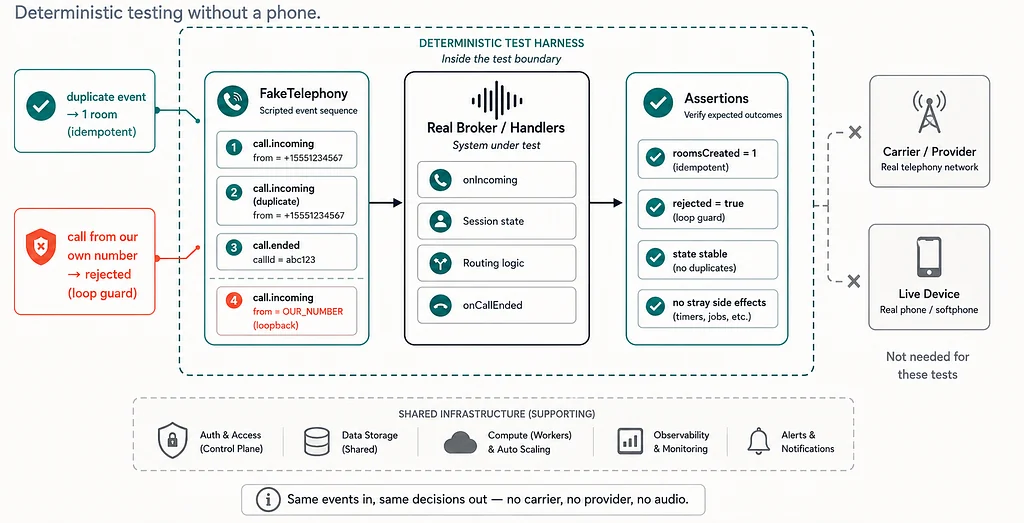
The trap with real-time systems: the happy path is trivial and the hard cases only happen mid-call. You can’t reproduce a double-delivered event or a forwarding loop by dialing in and hoping — that’s a séance, not a test.
Because the conversation is a state machine driven by stateless handlers, you can drive it directly. Build a harness: a fake telephony client that emits the exact event sequences the real provider would, and assert on what the broker does — no carrier, no provider, no audio.
const phone = new FakeTelephony();
// duplicate delivery must be a no-op the second time
await onIncoming(phone, evt("call.incoming", { to: TENANT_A }));
await onIncoming(phone, evt("call.incoming", { to: TENANT_A }));
expect(phone.roomsCreated).toBe(1);          // idempotent
// a call from our own number (a forwarding loop) must be refused
await onIncoming(phone, evt("call.incoming", { from: OUR_NUMBER }));
expect(phone.roomsCreated).toBe(1);          // loop guard held
The harness is deterministic — same events in, same decisions out — so a failure is a real regression, not flaky telephony. This is what makes the unhappy paths (early hangups, doubled events, loop guards, wind-downs) ordinary unit tests instead of hope.
9. Observability without exposing everything
Voice failures are felt emotionally: a slow page is annoying, but silence on a call feels broken and a failed transfer feels embarrassing. Operators need to answer “what happened on this call?” from facts, not guesses.
Capture state transitions, timing, tenant id, provider events, handoff attempts, and outcomes — and keep sensitive caller payloads out of the logs unless there’s a clear operational need.
log.info("call.answered", { tenantId, roomId, answerMs, sttMs });
// timestamps + tenant id, not transcripts
The same timing instrumentation that proves a test passes proves, in production, whether a slow call is your code or the provider having a bad afternoon — which once turned out to be a lapsed billing setting upstream, found in one log line instead of a day of bug-hunting.
Conclusion
When building a multi-tenant voice platform:
- Resolve the tenant first — before any model session, with no default.
- Split configuration from contract — tenants edit the body; the platform owns the footer, applied last.
- Treat a call as a session — idempotent handlers, reconciled against state.
- Scope every query — and make the unscoped query impossible, not just discouraged.
- Isolate credentials and cost — per-tenant keys, spend caps, concurrency limits.
- Run outcomes as workflows — the agent asks, the platform decides.
- Deliver durably — outbox over fire-and-forget; never lose a lead.
- Test without a phone — a deterministic harness over a real device.
- Observe without exposing — enough to debug, never a privacy liability.
The impressive part of a voice agent is that it can talk. The production part is that it talks as the right business, follows the right rules, survives messy events, hands off cleanly, records the outcome, and never mixes one tenant’s world with another.
The caller hears a voice. The business gets a lead. The platform in the middle does the quiet work — deciding who the agent is, what it may know, what it may do, and where the result goes. That quiet work is the product.